
Schedule Washmart Doorstep Pickup & Save Time
German-grade cleaning, free home pickup & express delivery from 400+ stores across 125+ cities in 28 states and 2 countries.
How washing tools, cleaning products and professional services changed the work of caring for clothes.
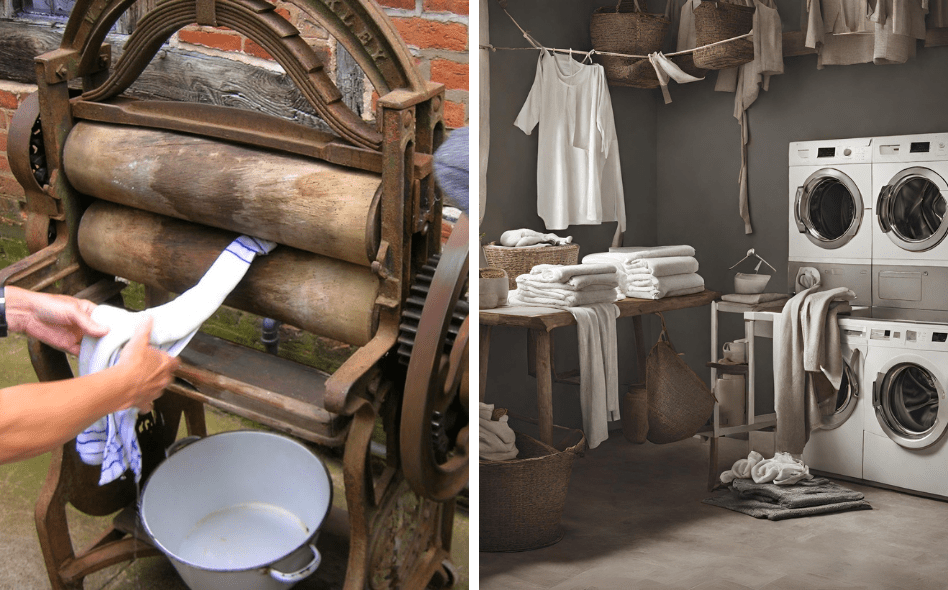
The evolution of laundry is the story of moving from labour-intensive washing towards more controlled and convenient garment care. Hand tools reduced some of the effort, powered machines took over repetitive movement, and automatic programmes combined several stages of washing into one operation.
Cleaning products developed alongside the equipment. Professional services also expanded the choices available to people who needed help with washing, finishing or specialised garment care.
This change did not happen everywhere at the same time. Access to water, electricity, money, space and paid laundry services shaped how households washed their clothes. Handwashing, machine washing and professional care continue to exist together.
How Did People Wash Clothes Before Washing Machines?
Before powered equipment, washing depended heavily on physical work.
People carried or collected water, prepared washing vessels, worked on soiled fabric, rinsed it and removed water by hand. Drying required suitable space and weather, while finishing could involve another substantial task.
Practices varied between places and periods. Rivers, communal washing areas, household tubs and dedicated washhouses provided different settings for the work.
Tools such as washing bats, boards and hand-operated agitators helped people move water through fabric or work on dirt. They did not eliminate the need to handle wet clothing repeatedly.
It is misleading to describe one method as the way everyone washed in the past. Household resources, local customs and the type of textile all influenced the process.
Washboards, Wringers and Early Laundry Equipment
Before fully automatic machines, many inventions addressed one part of washday at a time.
A washboard provided a textured surface for working fabric. A wringer used rollers to squeeze water from wet items. Other devices helped agitate clothing or manage drying and finishing.
The Smithsonian’s account of an 1878 laundry-equipment catalogue documents washing machines, wringers, mangling machines, laundry stoves and drying closets. It shows that specialised laundry equipment existed well before the modern automatic washer. Unbound
The important change was gradual mechanisation. A device might reduce effort in one stage while leaving the user responsible for filling, draining, transferring and handling the load.
This distinction explains why an early “washing machine” could still involve considerable manual work.
How Electricity Changed Laundry
Electric motors allowed machines to perform repetitive movement that previously depended on the user.
However, an electric washer was not necessarily automatic. Some machines still required manual water management or a separate wringer.
The Science Museum Group holds an electric washing machine with a wringer attachment dating to around 1929. This is a useful example of powered washing combined with a separate stage for removing water. Science Museum Group Collection
Electricity changed the work, but the full household routine still depended on the equipment available. Drying space, ironing and putting clothes away remained important parts of laundry.
From Separate Washing Stages to Automatic Programmes
Later designs brought more stages together.
Twin-tub machines used separate compartments for washing and spinning. Fully automatic machines integrated washing, rinsing and spinning into a programmed sequence.
These developments reduced the need to intervene between stages, although users still had to choose appropriate loads, products and settings.
The Science Museum Group notes that twin-tub washing machines became popular in Britain from the 1950s. That is a regional milestone, not a date for worldwide adoption. Science Museum Group Collection
Different machine types remain useful in different circumstances. The history of laundry is not a simple sequence in which every new design immediately replaced the previous one.
A Simple Timeline of Laundry Development
These stages overlap, and their adoption varied by region.
Broad stage | Main development | What changed for the user |
|---|---|---|
Manual washing | Water, cleaning agents and hand tools | Most physical work remained with the person washing |
Mechanical assistance | Washboards, hand-operated devices and wringers | Individual tasks became easier to organise or perform |
Powered washing | Motors drove washing mechanisms | Less manual effort was needed for repetitive movement |
Separate wash and spin systems | Different compartments handled different stages | Water removal became more mechanised, with transfers still required |
Automatic washing | Programmes combined washing, rinsing and spinning | Fewer interventions were needed during the cycle |
Modern garment care | More specialised programmes, products and services | Users gained more options for different clothing needs |
Digitally arranged services | Online enquiries and collection scheduling | Booking and transport could be organised remotely |
The biggest practical shift was the reduction of hands-on work within the wash itself. Preparation, decision-making and aftercare remained necessary.
How Soap and Detergent Changed Laundry
Equipment is only part of the story. Cleaning formulations developed too.
Soap has a long history, while synthetic detergents became an important part of twentieth-century laundry. Later formulations introduced different ingredients and product formats for particular cleaning requirements.
The American Cleaning Institute’s historical material describes developments including wider adoption of enzyme detergents and concentrated products designed to support effective lower-temperature washing. The American Cleaning Institute (ACI)
Why More Specialised Products Matter
A laundry product can contain ingredients with different jobs, such as helping remove oily soil or addressing particular stain components.
This gives users more choices, but it also makes instructions important. A concentrated detergent should not be measured as though it were a less concentrated product.
A modern product is not automatically suitable for every fibre. Wool, silk, technical clothing and garments with special finishes may have specific restrictions.
More Products Do Not Always Mean Better Results
Adding several boosters to a load is not a measure of progress.
The useful development is being able to choose an appropriate product and dose for the task. Following instructions remains more important than using the largest number of products.
How Modern Laundry Techniques Improve Control
Modern laundry equipment can provide more control over the conditions used for a load.
Depending on the machine, users may be able to select temperature, programme, spin speed and other settings. Some models also offer features that adjust parts of the process.
The practical benefit is the ability to match the equipment more closely to the clothing. It does not remove the need to read labels.
Sorting Still Comes First
A machine cannot make incompatible garments suitable for one wash.
Colour, fabric, construction and soil level still influence how a load should be prepared. A delicate item should not be added to a heavy-duty wash simply because the machine is new.
Stains Still Need Assessment
A specialised programme does not guarantee complete stain removal.
The substance, age of the mark, fabric and previous treatment all matter. Some garments need targeted treatment before or after the main cleaning stage.
Read how laundry services remove tough stains for a closer look at that process.
Drying Is a Separate Decision
Washing and drying requirements are not interchangeable.
Items washed together may need different drying methods. A tumble dryer, drying rack or flat-drying arrangement should be selected according to the garment’s instructions.
The development of more equipment has expanded the options, but choosing correctly remains essential.
Where Does Dry Cleaning Fit Into Laundry History?
Dry cleaning represents a different cleaning route from ordinary water-based laundering.
The term does not mean that no liquid is used. It refers to cleaning with a solvent system rather than a conventional water wash.
It is relevant for garments whose materials, construction or care instructions call for that process. It should not be treated as the automatic choice for every expensive item or difficult stain.
Modern professional care involves selecting a suitable method for the complete garment, including its lining, trims and condition.
For clothing that may need this route, enquire about Washmart dry cleaning services and provide the care-label details.
Traditional Laundry Methods vs Modern Techniques
Older and newer methods differ mainly in how work is performed and controlled. Neither label alone establishes that a method suits a particular garment.
Aspect | Manual or traditional approach | Modern equipment and services |
|---|---|---|
Physical work | More direct washing, rinsing and water removal | Machines can perform repetitive stages |
Control | Depends heavily on the person carrying out the work | Programmes and settings can support repeatable treatment |
Time | Requires substantial active involvement | Can reduce active work during processing |
Fabric decisions | Depend on the washer’s knowledge | Still require care-label checks and appropriate choices |
Drying | Often relies on available air-drying space | May include several drying options, subject to garment suitability |
Convenience | Organised around household labour or local help | Can include collection, delivery and remote booking |
Handwashing remains appropriate for some garments. Professional cleaning also involves manual inspection and treatment alongside equipment.
The useful question is not whether a method is old or new, but whether it is right for the item and situation.
The Evolution of Laundry Services in India
In India, household washing and local laundry services have long existed alongside one another.
Today, customers may combine handwashing, domestic machines, neighbourhood ironing services and organised laundry outlets. Their choice depends on garment needs, available space, time, cost and local access.
For one household, the challenge is drying a large wash. For another, it is finding time to iron office clothing. A person with a delicate occasion garment may need assessment rather than routine washing.
Organised services provide another way to handle these tasks. Their value depends on clear service selection, suitable care, pricing and communication.
This is a broader range of choices, not evidence that every household needs the same arrangement.
How Pickup and Delivery Changed Laundry Convenience
Collection and return services address a different part of the process: getting clothing to and from the laundry.
Customers can arrange care without necessarily making two store visits. Where digital booking is available, they can also submit contact details and preferred collection times remotely.
The benefit depends on practical arrangements:
Coverage at the customer’s address.
Available collection windows.
Clear garment or order records.
Confirmed services and charges.
An agreed return schedule.
Learn more about the benefits of laundry pickup and delivery.
Digital convenience should support the cleaning service. It does not replace the need to communicate stains, damage or special instructions.
Does Modern Laundry Always Use Fewer Resources?
Not automatically.
Resource use depends on the machine, programme, water heating, load size, drying method and operating practices. Professional services also involve processing and transport.
A newer machine or an “eco” label does not, by itself, prove the outcome for every wash.
Practical decisions include following the appliance’s load guidance, avoiding unnecessary repeat washing, measuring products correctly and choosing suitable settings.
Any claim that a service saves a particular amount of water or energy needs a clear basis for comparison.
How Washmart Fits Into Modern Garment Care
Washmart offers services such as wash and fold, wash and iron, woollen laundry, ironing and dry cleaning. Customers can choose help according to the garments and the tasks they want handled.
For example, a household might manage most washing at home while sending suitable items for ironing. Another might use wash and fold during a busy period.
Explore Washmart laundry services and discuss the care requirements before booking.
Useful information to share includes:
Garment types and care labels.
Stains and previous treatments.
Required finishing.
Your location.
Any fixed return deadline.
The value of modern service lies in matching the process to the item and making the arrangement clear.
What Could Shape the Future of Laundry?
Likely areas of development include easier programme selection, more efficient equipment, improved product dosing and better communication between customers and service providers.
These are directions to evaluate, not guarantees about what every future machine or laundry will offer.
The most useful improvements will solve everyday problems: choosing the right care, avoiding wasted treatment, recording orders accurately and returning items when expected.
Technology still needs to work alongside textile knowledge and careful handling.
Choose the Right Care From Today’s Options
Laundry has changed through improvements in tools, products, machines and service access. The result is a wider choice of ways to manage clothing care.
Use those choices according to the garment and your routine. For tasks that need professional attention, discuss the requirements with Washmart before selecting a service.
Frequently Asked Questions
Got questions? Here are common queries and expert answers about this guide.
How did people wash clothes before washing machines?
Methods varied, but washing generally involved water, cleaning agents, manual agitation, rinsing and hand removal of water. Tubs, boards and other tools helped with particular stages.
What was a washboard used for?
It provided a textured surface against which fabric could be worked during washing. It was one of several tools used to assist manual laundry.
What did a laundry wringer do?
A wringer used rollers to squeeze water from wet clothing. It helped with water removal but was separate from other washing tasks.
Were early electric washing machines fully automatic?
No. Electricity could power the washing movement while filling, draining or wringing still required separate handling.
What is the difference between a twin-tub and an automatic machine?
A twin-tub typically separates washing and spinning into different compartments. An automatic machine combines several stages in a programmed sequence.
How did detergents change laundry?
Developments in formulation expanded the ways cleaning products could address soils and stains. Appropriate dosing and fabric compatibility remain important.
Is handwashing outdated?
No. Some garments still require or permit handwashing. The care instructions determine whether it is appropriate.
Does dry cleaning mean cleaning without liquid?
No. Dry cleaning uses a solvent-based process rather than a conventional water wash. The garment needs assessment for suitability.
Are modern machines suitable for every garment?
No. Construction, fibres, trims and care labels still limit what can be machine washed or dried.
Have laundry services replaced home washing?
No. Many people combine home care with professional help for selected tasks or garments.
Is professional laundry always more environmentally efficient?
No universal comparison applies. Equipment, loads, products, drying and transport all influence resource use.
How can I choose a suitable Washmart service?
Contact Washmart with your location, garment details and required finish. Confirm the appropriate service, price and return arrangements.
