
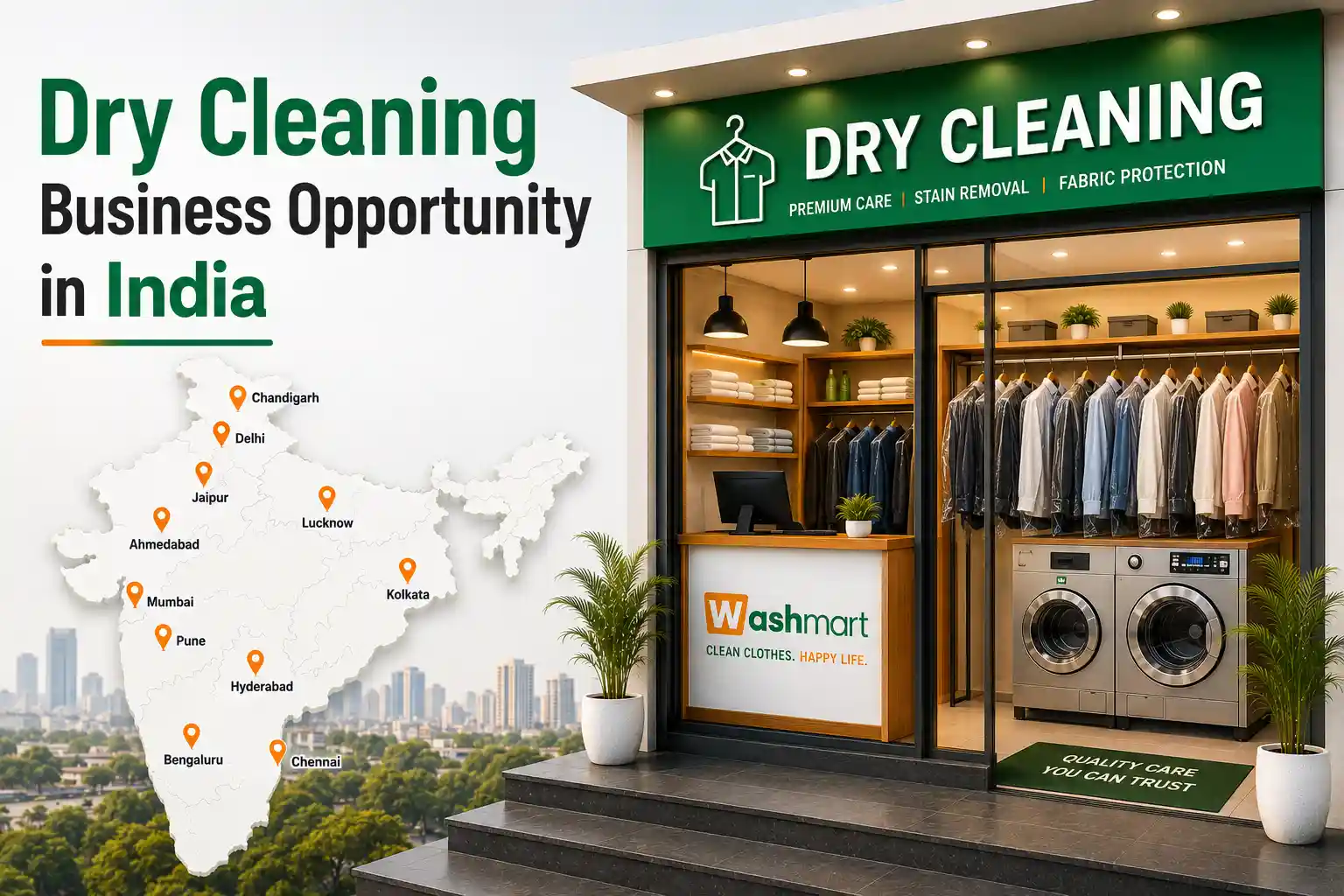
Start a High-ROI Washmart Franchise in Your City
Low capital setup, European machinery, and complete operational guidance.
The numbers indicate the overall industry opportunity. Individual business performance will depend on location, pricing, competition, operating costs and customer demand.
Why is Dry Cleaning Becoming a Business Opportunity?
The opportunity is driven by a simple change in customer behavior:
People are increasingly willing to pay for convenience and professional garment care.
Several factors contribute to this.
1. Busy urban lifestyles
Professionals and families often have limited time for washing, ironing and maintaining delicate garments. Instead of handling everything at home, they can outsource garments that require specialized care.
2. More expensive and delicate clothing
Customers are spending more on formalwear, occasion wear and premium fabrics. A ₹10,000–₹50,000 garment is less likely to be treated the same way as everyday clothing. This creates demand for specialized cleaning.
3. Wedding and occasion wear
India has a large market for: Sarees, Lehengas, Sherwanis, Suits, Designer dresses, Wedding gowns, Blazers These garments are often used occasionally and require cleaning before storage or reuse.
4. Growing apartment culture
Large residential societies create concentrated customer bases. Instead of acquiring customers one household at a time across an entire city, a business can potentially target several hundred or thousand households within a limited delivery radius.
5. Business customers
The opportunity isn’t limited to households. Hotels, hospitals, restaurants, salons, offices and other organizations may require regular textile and garment-care services. This creates a potential B2B revenue channel alongside residential customers.
What Services Can a Dry Cleaning Business Offer?
A modern dry cleaning business doesn’t necessarily have to depend only on dry cleaning. A broader service portfolio can include:
- Garment Services – Dry cleaning, Laundry, Wash & fold, Steam ironing, Stain treatment, Premium garment care
- Household Textile Services – Curtain cleaning, Carpet cleaning, Blanket cleaning, Sofa and upholstery cleaning
- Other Services – Shoe cleaning, Sneaker cleaning, Pickup and delivery
This is where the business opportunity becomes broader. Instead of depending on one service, the business can build revenue from multiple customer requirements.
Dry Cleaning Business Models in India
There are several ways to enter the industry.
Independent Dry Cleaning Shop
You establish your own brand and manage everything yourself. This gives you control over: Pricing, Services, Equipment, Staff, Marketing, Store design But you also have to build the entire operation from scratch.
Laundry + Dry Cleaning Business
This is a broader model. Customers can use the same business for regular clothes as well as specialized garments. For example:
- Monday: Regular laundry
- Wedding season: Saree and lehenga dry cleaning
- Office wear: Suit and shirt cleaning
- Home requirement: Curtain and carpet cleaning
This gives the business more opportunities to generate repeat orders.
Pickup & Delivery Business
Customers don’t necessarily need to visit the store. The basic process is:
Pickup → Processing → Quality Check → Packaging → Delivery
This model can work particularly well in areas with apartments, working professionals and digitally active customers.
Centralized Processing Model
In larger operations, customer-facing outlets can function primarily as collection and delivery points while processing is handled through a centralized facility. This can help standardize processing as the business expands.
Dry Cleaning Franchise
A Dry cleaning franchise allows an entrepreneur to operate under an established brand and business framework. Depending on the franchise model, support can cover areas such as: Store setup, Training, Branding, Technology, Marketing, Recruitment, Operations
A franchise can be particularly relevant for entrepreneurs who prefer an established system instead of creating every business process independently.
Who are the customers of a dry cleaning business?
Understanding the customer is more important than simply knowing the market size.
Residential Customers
- Working professionals
- Families
- Students
- Apartment residents
- High-income households
- Wedding customers
Corporate Customers
- Offices
- Hotels
- Restaurants
- Hospitals
- Salons
- Retail stores
- Uniform-based businesses
Institutional Customers
- Hostels
- Universities
- Hospitals
- Hotels
- Guest houses
- Service apartments
A business can therefore have both B2C and B2B revenue streams.
Where is the Dry Cleaning Business Opportunity in India?
The opportunity isn’t limited to metros. Different types of cities can provide different advantages.
Metro Cities
These cities have large populations and substantial professional and commercial activity. However, they can also have: Higher rent, Higher competition and Higher marketing costs
Tier 2 Cities
- Jaipur
- Lucknow
- Indore
- Nagpur
- Kochi
- Coimbatore
- Chandigarh
- Vadodara
- Nashik
- Bhubaneswar
These cities can offer a combination of growing urban populations, professionals, students and relatively different operating economics compared with major metros.
Smaller and Emerging Cities
- Organized competition is limited
- Residential clusters are growing
- Customers are willing to pay for convenience
- Pickup and delivery can cover a suitable area
The key is not simply city population.
It is: Potential customers × spending ability × competition × operating cost
How to find the right location for a dry cleaning shop?
Before opening a dry cleaning business, study the locality rather than selecting a city first. Look for:
- Residential density – Are there apartments, gated societies or dense residential neighborhoods?
- Working professionals – Are there IT parks, corporate offices or commercial centers nearby?
- Premium customers – Are there households that regularly purchase formalwear, occasion wear or premium clothing?
- Hotels and businesses – Can the location generate B2B orders?
- Competition – How many existing laundries and dry cleaners are within your delivery radius?
- Rent – Can the expected order volume support the monthly occupancy cost?
- Accessibility – Can customers easily reach the store?
- Delivery potential – How many households and businesses can realistically be served within a practical pickup and delivery radius?
How Much Does It Cost to Start a Dry Cleaning Business?
There is no single investment amount. The cost depends on whether you choose:
Small retail outlet or Laundry + dry cleaning store or Full processing facility or Pickup and delivery model
Your major expenses may include:
| Expense | Approximate Consideration |
|---|---|
| Store deposit | Depends on location |
| Interior | Depends on size and format |
| Equipment | Depends on processing model |
| Staff | Monthly operating expense |
| Packaging | Recurring expense |
| Technology | POS/order management |
| Marketing | Launch + ongoing |
| Delivery | Vehicle/rider/logistics |
| Working capital | Essential for initial months |
The biggest mistake is to calculate only the opening cost. You should also calculate:
How much money is needed to operate the business until monthly revenue becomes stable?
How Much Can a Dry Cleaning Business Earn?
There is no fixed monthly income for every dry cleaning business. Revenue depends mainly on:
- Number of orders
- Average order value
- Service mix
- Repeat customers
- B2B contracts
- Delivery orders
For example: Suppose a business receives:
40 orders per day with an average order value of: ₹500 and operates for: 26 days
Then: 40 × ₹500 × 26 = ₹5.2 lakh monthly revenue
This is only an illustrative calculation, not an industry or Washmart revenue projection.
From this revenue, the business still has to pay:
- Rent
- Salaries
- Utilities
- Processing costs
- Packaging
- Delivery
- Marketing
- Maintenance
- Taxes
So revenue should never be presented as profit.
Dry Cleaning Business vs Laundry Business
| Factor | Laundry | Dry Cleaning |
| Primary need | Routine garment care | Specialized garment care |
| Common garments | Everyday clothing | Delicate, formal and premium garments |
| Order frequency | Often higher | Depends on garment type |
| Service type | Volume-focused | Specialized |
| Customer base | Broad | Specialized + premium |
| Business opportunity | Everyday garment care | Higher-value specialized services |
For entrepreneurs, combining the two can provide a broader service offering than operating only one category.
Independent Business vs Dry Cleaning Franchise
| Factor | Independent Business | Franchise |
| Brand | Built from scratch | Existing brand |
| Business processes | Owner develops them | Established framework |
| Training | Self-arranged | Franchise support |
| Store setup | Owner-managed | Guided depending on model |
| Marketing | Self-managed | Brand support may be available |
| Technology | Owner selects | May be included |
| Flexibility | Higher | Must follow brand standards |
| Initial responsibility | Entirely with owner | Shared through franchise system |
Neither option is automatically better.
An independent business may suit an entrepreneur who wants complete control and has the capability to build the operation.
A franchise may suit someone who wants an established business framework and structured support.
How Washmart Fits Into the Opportunity
Washmart is relevant to this discussion because it operates within the broader laundry and garment-care industry, rather than because every dry cleaning business needs to be a franchise.
The brand currently states that it operates 350+ stores across 122 cities, giving it experience across different Indian markets.
Its service portfolio also extends beyond dry cleaning and includes services such as laundry, ironing, shoe care and other cleaning services.
That broader service mix illustrates one important point for entrepreneurs:
The business opportunity can be larger when dry cleaning is treated as part of a complete garment-care business rather than as a single standalone service.
For someone who wants to start independently, this can be used as a business-model reference.
For someone who prefers an established brand, Washmart’s franchise model can be evaluated separately based on its current investment, support and commercial terms.
That distinction keeps the article focused on the business opportunity, while still giving Washmart a natural place in the discussion.
How to Start a Dry Cleaning Business in India
A practical approach is:
1. Study the local market – Identify customer segments, competitors and pricing.
2. Select the business model – Choose independent, combined laundry and dry cleaning, pickup and delivery or another model.
3. Select your target locality – Compare rent, customer density and competition.
4. Calculate the investment – Include equipment, interiors, deposits and working capital.
5. Decide your service portfolio – Don’t automatically offer every service from day one. Start with services that have clear local demand.
6. Set up operations – Develop systems for Garment tagging, Inspection, Processing, Quality control, Packaging, Delivery
7. Build local visibility – Use Google Business Profile, Local SEO, Apartment partnerships, Referral programs, Social media, Local advertising, B2B outreach
8. Track the numbers – Monitor Orders → Average Order Value → Revenue → Costs → Repeat Customers → Profit
This will tell you whether the business model is actually working.
Final Takeaway
The dry cleaning business opportunity in India is expanding as consumers look for professional garment care, convenience and specialized cleaning.
For entrepreneurs, the opportunity can take several forms: Independent dry cleaning shop, Laundry + dry cleaning outlet , Pickup and delivery business, B2B garment-care service, Branded franchise
The right model depends on the target market, available investment and operational capabilities. And rather than choosing a city simply because it is large, entrepreneurs should identify specific localities where residential, professional and commercial demand can support the business.
India’s growing demand for convenient, organized and professional garment care creates room for entrepreneurs who can identify the right market and execute the business well.
